Lake Mead N.R.A.

Lake Mead N.R.A.
READY TO ROLL!

Friday, December 3, 2010

Restocking an Endangered Fish, The Bonytail Chub

December 3, 2010. Bill Williams River National Wildlife Refuge
Today, Joyce and I had the opportunity to work with some U.S. Fish and Wildlife Fisheries Biologists releasing endangered Bonytail Chub into the Colorado River and Lake Havasu.
Endangered Status The Bonytail Chub is on the U.S. Endangered Species List. It is classified as endangered throughout its range in Arizona, California, Colorado, Nevada, and Utah. This fish lives in large, fast-flowing waterways of the Colorado River system, and the large-scale damming of the river has diminished available habitat. Water-management practices such as damming and channeling not only change the speed, location, and volume of flow, they change the temperature and the clarity of the water and block migration routes. Other threats to the Bonytail Chub have been the introduction of non-native fish that compete for food and habitat, and may prey on it or hybridize with it.
The BonyTail Chub were released in two locatons. The first location was La Paz County Park on BLM land on the Colorado River south of Parker Dam.
Bonytail Chub Description To 24" (61 cm). Moderately elongate; greenish-gray above, sides lighter, whitish below. Breeding males reddish-orange below and on paired fins. Head short; snout depressed, broadly rounded, usually not overhanging upper lip; hump on nape in adults. Fins large, slightly falcate; usually 10 dorsal fin rays; 10-11 anal fin rays; caudal peduncle very narrow; caudal fin deeply forked. 75-88 lateral line scales; scales embedded or absent on predorsal area, belly, and caudal peduncle.
These Bonytail Chub were raised by the fisheries in various ponds before being released. They are released into the Colorado River systems once a year at this time. At this location 900 fish were released into the river.
The Bonytail Chub is so endangered that some biologists would argue that they are genetically extinct as they have not been able to establish that any Bonytail Chubs alive today have not been reproduced and raised in hatcheries. They do not seem to be successfully reproducing and thriving in their native environments.
Endangered species
Any species which is in danger of extinction throughout all or a significant portion of its range. Aspecies whose numbers are so small that the species is at risk of extinction.Where the populationof a species is dangerously low, so much that their gene pool diversity is adversely affected while there is a risk of the species being wiped out all together, usually a consequence from humangain.
All of the Bonytail Chubs that were released have an identification type chip (similar to pet chips) embedded in their body. However to track the Bonytail Chub movements in the rivers and lakes some of those that are released have a tracking sensor surgically placed in their body. Here near the shore at our refuge, biologists were inserting the sensors in the abdomen of 20 select Bonytail Chub.

The Bonytail Chub are first anesthetized in a water solution.

The capsule shaped sensor below is inserted in a select Bonytail Chub.
It's not every day that I get to hold the most endangered fish in the Colorado River! Intentionally killing or molesting this fish could result in a $10K fine. This one has been anesthetized for surgery to implant the sensor above.
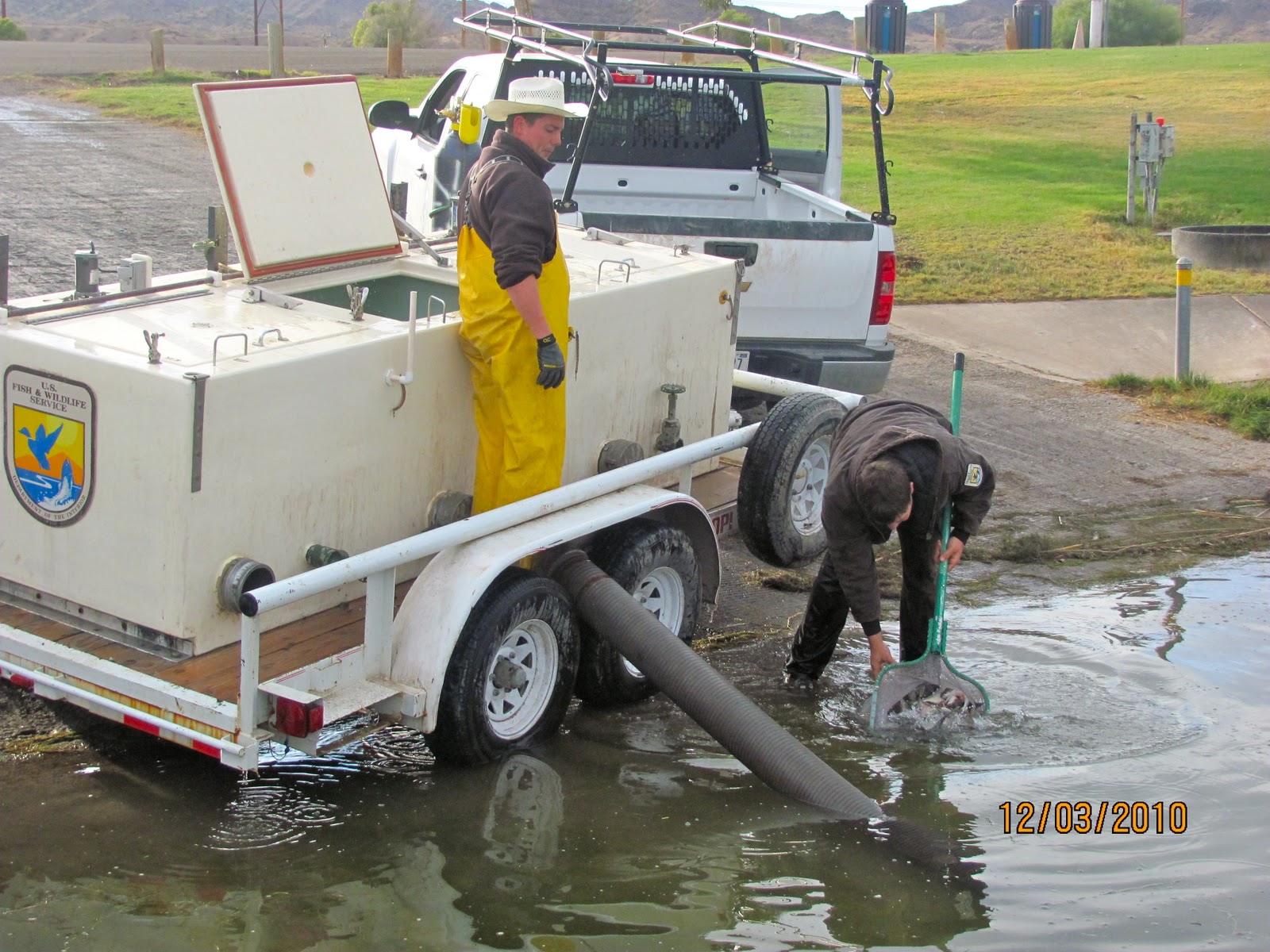
A large truck from the hatchery carrying 2100 Bonytail Chub arrived at our refuge to release it's cargo into Lake Havasu.
The fisheries personnel were sure to match the water temperatures of the holding tanks with the lake. In this case the water was about 57 degrees.
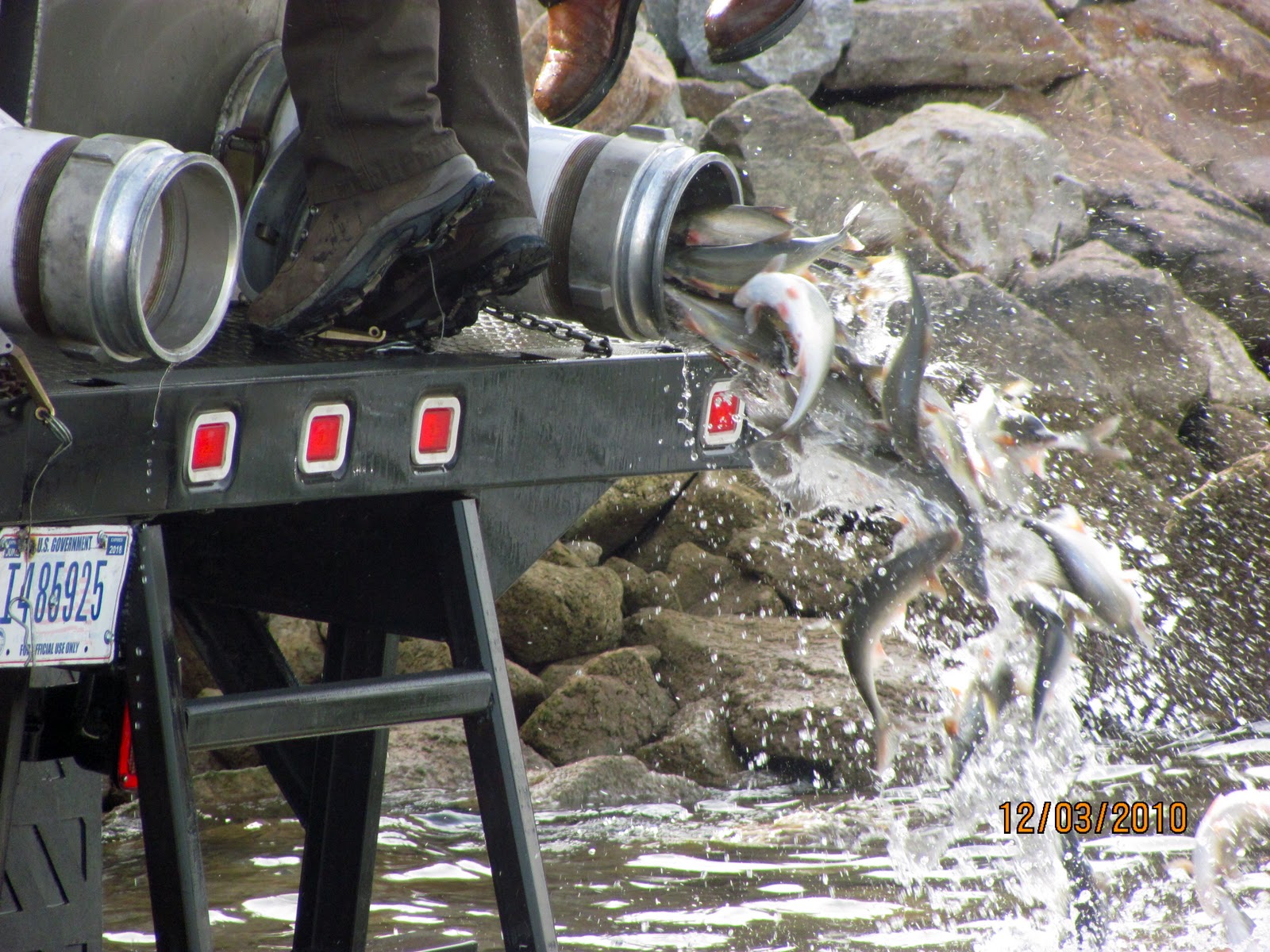
Not exactly a graceful exit!
Both the Razorback Sucker and the Bonytail Chub have trouble competing against introduced species in an environment in the Colorado river that has changed from a warm flowing turbulent river to a series of cool calm lakes. To protect these endangered species, water releases from dams are regulated to protect spawning areas. Ambitious stocking and habitat improvement programs as well as intense scientific study are aimed at restoring self sustaining populations wherever possible within their natural environment.
We enjoyed our opportunity to participate in this important attempt at saving the Bonytail Chub from extinction.

Thursday, December 2, 2010

Hike out on the Bill Williams River NWR

December 2, 2010. Bill Williams NWR
The last couple of Days we did some hiking off Planet Ranch Road within the refuge. 
Our dusty Rubi on Planet Ranch Rd.
Yesterday, we hiked a short distance past the slot canyon at the 1.5 mile marker on Planet Ranch Road. Our hike was short because we came across a barbed wired fence. Today we went back and finished the hike after learning that the fence was left over from when cattle used to roam around Planet Ranch Road. We bypassed the fence today by hugging the canyon wall and climbing over a small bluff. Looking back through the slot canyon you can see the hole in the rock below.

Once past the slot canyon walking in the direction of the Bill Williams River, the fauna gets thick with cactus, Mesquite, Palo Verde and Creosote. We came across a number of very tall Saguaro Cactus.


The magnificent Saguaro Cactus, the state flower of Arizona, is composed of a tall, thick, fluted, columnar stem, 18 to 24 inches in diameter, often with several large branches (arms) curving upward in the most distinctive conformation of all Southwestern cacti.

The skin is smooth and waxy, the trunk and stems have stout, 2-inch spines clustered on their ribs. When water is absorbed , the outer pulp of the Saguaro can expand like an accordion, increasing the diameter of the stem and, in this way, can increase its weight by up to a ton
.

The Saguaro has a surprisingly shallow root system , considering its great height and weight. It is supported by a tap root that is only a pad about 3 feet long, as well as numerous stout roots no deeper than a foot, emanating radially from its base. More smaller roots run radially to a distance equal to the height of the Saguaro. These roots wrap about rocks providing adequate anchorage from winds across the rocky bajadas.


Joyce enjoyed the hike!
After completing the hike through the slot canyon and along the river, we decided to drive to the end of Planet Ranch Road and try one of the trails that lead away from the river into the desert toward the Buckskin Mountains.
Buckskin Mountains is a mountain range in La Paz County in the state of Arizona (AZ). Buckskin Mountains climbs to 1,496 feet (455.98 meters) above sea level. Buckskin Mountains is located at latitude - longitude coordinates (also called lat - long coordinates or GPS coordinates) of N 34.155298 and W -113.830771.
A large wash surrounded by the Buckskin Mountains
We enjoyed our hikes and decided to call it a day as the shadows were getting long! The contrast between the desert and the riparian area around the river is amazing.
Tomorrow we are back to our 3 day work/ volunteer schedule here at the refuge so we'll see what's new!

Tuesday, November 30, 2010

Replacing the Sewer Hose and Other Fine Chores

November 30, 2010. Bill Williams NWR
The Cattails lining The Bill Williams River and Confluence into Lake Havasu are turning yellow.
We are beginning to get the hitch itch. We have about 3 more weeks here at the refuge as we are tentatively planning to leave a little early before Christmas. You may recall that we arrived here a month early at the end of August. When we arrived we were told that if we completed 500 hrs. of volunteer work we would get a National Parks Pass good for a year. We are over that mark so we are looking forward to that reward.
Yesterday, I received a new sewer hose that I had ordered from Drain Master. Our Carriage Cameo came with a cam fit sewer hose system made by Drain Master. The system uses cam fittings instead of the typical bayonet fittings. New this year is a Polychute hose that is supposed to be nearly indestructible. It has a clear tube portion next to the unique nozzle for monitoring the flow when dumping the tanks (isn't that exciting)! The hose can be sealed at both ends for storage with the valve lever on one end and a red cap at the other. The new hose is 16 ft. long when stretched. I've never needed anything longer than that. The hose complete with fittings cost $150! It better outlast the other one!
I ordered the new hose because the previous one has suffered in the heat and sun. The old hose and nozzle fitting got constant exposure to the sun during the day which discolored it to a burnt shade.
In addition the hose itself developed small holes on the top either from the sun or from critters chewing on it.
I'm going to continue to use the old hose till we leave as it is not leaking on the ground and I don't want to risk exposing my new hose system to whatever created the holes! The new one fits nicely in the sewer hose compartment bay on the side of our Cameo.

Today was our day off so I got to work installing the hinges and cabinet supports in the rig that I had wrote about a few days ago. I've also begun waxing the rig in sections and making small preparations to depart such as emptying and flushing the water tank.
New neighbors arrived today. They will be doing volunteer work for the refuge ecologist, counting birds, plants etc.
We have the next two days off. We are currently thinking of doing a hike but we'll see what happens. It's been pretty cold with temps in the upper 30's in the morning and a high in the 50's today. It's not bad in the sun as long as the wind isn't blowing.